Showing posts with label daily life. Show all posts

Wednesday, January 02, 2008

Happy New Year!

What a joy to welcome in 2008 with my husband, brother and sister-in-law at the First Night Akron celebration! Even though this event has been going on every New Year's Eve for the past twelve years, this was my first time attending it, but it will not be my last.

After a great dinner at the Otani Japanese Restaurant in the Merriman valley, we went downtown to explore a virtual smorgasbord of entertainment, all for the cost of our $10 button; even the parking and bus ride around town was included. My personal favorite was the Magical Theatre Company’s presentation of Bunnicula at the Akron Library. The comments of the little 3 or 4 year old sitting behind me during the play were as entertaining as the performance. There was certainly something for everyone from toddler to senior citizen at this celebration. My husband’s favorite was the harmony of the Akron Derbytown Barbershop Chorus at St. Bernard Church, and we all enjoyed the great rhythms of the University of Akron’s Steel Drum band.

We kept warm jumping around to the beat of “Cats on Holiday” as the New Year approached and welcomed in 2008 with a bang, blaze of colors, and the rockin’ sound of music from Akron’s WKDD radio. I had a great New Year’s Eve and didn’t even touch a drop of alcohol. It was enough of a high to celebrate with our community and look through the free 3D glasses at the kaleidoscope of color that emanated from the fireworks. I never realized that you could get such a psychedelic effect that way. If you have never attended First Night Akron, you might want to give it a try next year. I plan to make it an annual event.

Now that the holiday is over, I am resolving to be more organized and stay in shape. I make these resolutions at the start of every year, but I never keep them to my satisfaction. I also am making a new commitment to citizenship this year. I've posted my political resolutions on the Cosmic Message Blog.

Happy 2008 to all!

Monday, July 23, 2007

Sicko and Harry Potter

Call me cheap or just not very interested in pop culture, but I normally wait for the movies to come out on DVD and borrow them from the local library or watch them on TV. This weekend was a first for me. I just couldn't resist seeing two movies at the theater.

I love the creativity and fantasy of the Harry Potter books and when paired with the magic of Hollywood special effects artists, the Harry Potter movies just have to be seen on the big screen. After getting a great Harry Potter fix at the movie, I can now peacefully curl up and read the Deathly Hallows. It could be a few days until I post on this blog again. Is there such a thing as a "Potter Overdose"?

Michael Moore's Sicko had me laughing, but there is nothing funny about the American health care system except the American public's willingness to accept it in the name of "free market capitalism" and as a result of savvy marketing and political contributions by the insurance and drug industries. I have to admit, I had tears in my eyes as the 9/11 rescue workers got compassionate treatment from the Cuban doctors that they couldn't get at home.

Maybe if we ask Castro nicely, he will offer care to some of our wounded Iraq War Vets who can't seem to jump through the right hoops to get the care they were promised. Maybe the Cubans would help out the never mentioned civilian contract workers who have been wounded or are suffering from PTSD. I wonder how many of these American heroes will be denied health insurance later in life because of preexisting conditions they acquired during their service to our country. I wonder if the government will deny that the war had anything to do with these conditions. I wonder how many of the surviving spouses and children of those who have died will be unable to afford treatment if they become ill. Just some interesting facts about those contractors though it isn't even possible to get accurate statistics about how many there are or how many have died or been wounded.

"In Iraq today, an estimated 126,000 Defense Department civilian contractors support 145,000 troops. Thousands more civilians work under contract to other U.S. government agencies."

"After The New York Times submitted a Freedom of Information Act request, the Department of Labor acknowledged 917 deaths, including at least 146 during the first quarter of 2007. Another 12,000 have been wounded or hurt, and those numbers almost certainly underestimate the true toll."
Rosa Brooks

If you want a true picture of all the people fighting this war in our name, you should read Brook's article or view the videos at Civilians at War.

I wonder if we pull out the troops if we will bring the civilians out too.

OK, I've had enough politics and real life for a bit, I'm off to lose myself in a magical world with some of my favorite book people. Catch you in a day or two.

Sunday, July 22, 2007

Sex Education for Five Year Olds

I just had to laugh at the conversation between Bill O'Rielly and Rev. Haffner. I remembered my conversations with our son at age five when I was pregnant with his sister. We had explained of course that his sibling was growing in mommy's tummy and let him feel the baby kick. I should have used the word uterus because the conversation went like this:

Jon: How's the baby gonna get out? Are you gonna puke it up?
Mom: The doctor's going to take it out in the hospital.
Jon: Oh ...
Jon: So how did it get in there? Did you swallow it?
Mom: It's really hard to explain ummm. Maybe your dad can explain it better.

This bought me some time. It was a couple of days before he started asking the questions again when his dad was home. By this time we were better prepared. A really curious five year old has a lot of questions, and you can't put them off forever. I guess O'Rielly hasn't been around many curious five year olds interested in how things work. I had gotten pretty good at answering questions by the time our daughter started asking them and her older brother was more than happy to give her the benefit of all he had learned about the process. Guess the five year olds in O'Rielly's life didn't have older siblings and playmates willing to share information and misinformation about sex with his kids. Some of the misinformation and information they got from their friends and brought home was truly amazing.

Saturday, May 26, 2007

While I Haven’t Been Blogging

Lately, I haven’t been blogging because I have been busy watching the birds. I’ve started a new routine in the mornings where I only spend an hour watching the news and C-Span while I eat my breakfast. Then I take a half hour walk to listen to and watch the birds along the path by my house before getting ready for work. It is a beautiful walk, and I always feel refreshed by the time I come home.

Today was gray, but enjoyable just the same. I saw several goldfinch, some red winged blackbirds, robins, blue jay, morning dove, geese flying and honking overhead, sparrows, grackles, wrens, and I heard but didn’t see a wood thrush. Three rabbits crossed my path and hopped away with their little white tails bobbing up and down and some squirrels chased each other around and through the trees.

When I come back from my walk, I spend an hour doing things I need to do but have been putting off. Things like cleaning my drawers, scrubbing places that don’t show but need to be scrubbed, etc. I also spent some time mulching the flower beds and planting flowers and washing and waxing the car.

A couple weeks ago I took a drive to Holmes County to put flowers on my parent's and grandparent's graves and visit my Aunt Margaret who is 97 years old. She lives in a retirement community in Walnut Creek I stopped at Trail on the way to get some yummy Trail Bologna and Swiss Cheese. The drive there brought back all the great memories from my childhood.

My grandparents had a farm near Wilmot that was about 50 acres. The great thing about that farm was that it had everything on it one needed to survive. They had four or five Jersey and Guernsey cows that provided milk and cream. There were lots of chickens to provide eggs and an occasional chicken dinner. Grandpa also raised a few hogs every year. They had an orchard with apple trees, and there was a cherry tree and some quince trees that provided fruit. My grandmother's garden provided everything from rhubarb and strawberries to green beans, onions, potatoes and the best tomatoes I ever ate. Although they were not Amish, they had Amish and Mennonite roots and my grandfather farmed the fields with a team of horses that I liked to visit with in the barn. My grandfather also raised bees and my grandmother made her own butter from the cream their cows produced. Bread with homemade butter and honey and sweet corn in the summer! The farm is still a working farm owned by the Amish family my grandfather sold it to when he retired at age 83 after my grandmother's death. There is no bringing back those wonderful days of playing in the orchard, the woods or hay mow with my cousins, listening to my grandfather's stories and being the beneficiary of my grandmother's concerned attention to my health and appetite, but a drive through Holmes County in the spring sure brings back the wonderful memories that I am so fortunate to have.

As Jamie has posted on his site, Spring Is and you have to enjoy it while you can!

Wednesday, May 02, 2007

Freedom = Responsibility

My daughter, a young teacher, called me the other day upset because some of the students in her school had misbehaved on a field trip. It was a trip that involved the whole school, and the students’ behavior was an embarrassment to everyone involved. She had been instrumental in setting up the trip. She had helped convince the PTA to pay for it. She had looked forward giving the students this experience, but their behavior during lunch had disappointed and angered her. She was also a bit upset because other adults on the trip had given the students in their groups too much freedom. As a young teacher, she didn’t think she needed to tell veteran teachers not to let the students out of their sight in a strip mall. She called me for some motherly empathy and for some advice on what to say to the students the next day.

I told her to trot out my old “Freedom = Responsibility Lecture”. She had certainly heard it often enough during her childhood. It was one of my favorite parental lectures for my own children and for students that I taught. As a society, I think we need to talk more often about this equation. My lecture goes something like this.

Everyone loves freedom, but there can be no freedom unless everyone takes responsibility for maintaining it. The amount of freedom an individual gets is usually proportionate to the amount of responsibility she or he can handle. If someone shows that they cannot handle the responsibility to use their freedom wisely, someone else will step in and take that freedom away. It doesn’t happen only to children; it happens all the time in the adult world. Your freedom ends when you deprive someone else of their freedom or harm others by your behavior. In the case of students, it also ends when you bring harm to yourself because adults have a duty to protect you from making a mess out of your life before it gets started.

This was the first part of the lecture. Then I usually asked some questions about freedoms and responsibilities. What freedoms do you have? What responsibility did you take on when you got that freedom? For young children it might be “The freedom to walk to school by myself. I took on the responsibility to watch for cars, and to get there on time.” For older children, it might be “The freedom to spend time with a friend downtown without an adult. I took on the responsibility to behave appropriately in public so we didn’t deprive others of their freedom to shop in peace and safety. I obey the laws, so the police don’t arrest me for taking some else’s property or vandalism.” My lecture usually ended with depriving the child or students of rights until they could show that they were more responsible. The amount of freedom you have depends your willingness and ability to be responsible.

For adults it is no different. We have the freedom to drive and the responsibility to do so safely. If we fail to be a safe driver, the state (our fellow citizens) will take away our freedom to drive. A free society depends upon responsible people. As people take on more responsibility, there is less need for restrictive laws that spell out unacceptable behavior and punishments that restrict freedoms. I think that previous generations of Americans put more emphasis on responsibility than we do today. The adults of my childhood talked often about my responsibility and very little about my rights and freedoms. They often encouraged me to put myself in someone else's place to determine the effects of my behavior on others. That was my responsibility, to think about how my behavior would affect others. When I talk to students who are misbehaving today, they often demand their rights and freedoms, but are loath to accept the responsibility that goes along with those rights and freedoms. I see that in the adults I talk with as well. The imbalance in this equation seemed to take place somewhere in the late '60's, perhaps an outgrowth of the protests during the civil rights and Vietnam era. Conservative Christians suggest that the change in our culture is the result of taking prayer and Bible reading out of the public school, but I view the change as a result of placing too much emphasis on rights and freedoms and too little on responsibility, not only in our schools, but in society as a whole.

We each need to take responsibility for protecting the rights and freedoms of others along with our own. That is the foundation of a free society.

Some examples:

Parental rights come with the responsibility to care for the physical, educational and socialization needs of the child.

Property rights come with the responsibility to maintain and care for property so that it isn’t a health hazard and an eyesore for others who want to enjoy the property nearby.

Freedom of speech comes with the responsibility to speak the truth, not to endanger the community by inducing panic, and to use one’s speech for good, not for exploiting others.

Free enterprise comes with the responsibility to be fair in trading with others. It comes with the responsibility to maintain the community that supports it and provides the labor and raw materials for business.

Freedom to vote comes with the responsibility to carefully examine the issues and the candidates before voting.

A free society demands that each individual takes responsibility for creating the community and maintaining it. Today we are increasingly shifting the responsibility to “government”. There are many examples of people doing whatever they can get by with until stopped by law enforcement. Certainly laws can be made by “government” to regulate the behavior of people in any society, but by demanding laws to protect us instead of expecting responsible behavior from ourselves and our fellow citizens we are giving up our freedom, and we will cease to be a free society.

Saturday, April 21, 2007

All the Lonely People

My first reaction to the tragedy at Virginia Tech was of course great sadness and sympathy for the victims and their families. My second reaction was similar to that of Jeff’s at Have Coffee Will Write, the realization, not intellectually, but emotionally, that in other places in the world this happens every day. Then as I learned more about the young man who killed so many and ended his own life, I just kept hearing the Beatles song, “Eleanor Rigby”.


“All the lonely people,

Where do they all come from?

All the lonely people,

Where do they all belong?”

Cho Seung-Hui, was a lonely person. As a teacher, I have often had concerns about lonely students. I haven’t been worried that they would hurt others, but I know that they are in psychological pain, and I know that pain can bring them to the point of suicide. There are always those students who don’t fit in with the popular high school cliques. Sometimes they are teased or bullied, but often they are just ignored or students make a condescending effort to be inclusive though it is apparent to the loner that s/he is not a part of the group on an equal basis. Usually, the ones who don’t fit into the major cliques find some friends and form a group of what I like to term individualists. Since I was a member of one of these “misfit” groups in high school, I find myself drawn to the individualists. I know what it is like to not fit into the clique but have a small group of friends who accept you just the way you are warts and all. Adolescence is a time where a person needs a group, any group. From the information I’ve seen in the media, Senug was never able to find a place in adolescent society where he belonged, not even a group of individualists.


Erik Erikson describes adolescence as the stage of Identity vs. Role Confusion. It is interesting that Seung gave himself the name, Question Mark, a poignant expression of his inability to navigate the turbulent waters of adolescence. The roommates interviewed on television describe living with him for a whole year and never having a conversation with him. I can only imagine the pain he felt never being able to make a connection with anyone on campus. It would be like being in solitary confinement for years but able to watch others as they supported, and nurtured each other. Seung was in severe psychological pain. If we saw someone in comparable physical pain, we would rush him to the hospital. We would demand appropriate treatment, and we would do what we could to ease the pain. But this society does not recognize the need to treat psychological pain with the same urgency as physical pain. Even when parents or a close relative recognize the individual’s desperate need for help, treatment is difficult to get. For a good discussion of the difficulty of getting help for a family member listen to this discussion from NPR.


The news coverage of this story has filled me with sadness and anger. I am filled with sadness for the victims and their families, for Seung’s family and for Seung. I am angry because our society will fix the blame for this tragedy on Seung and do nothing to fix the problems in our mental health and legal systems. I am angry at the media for showing the images that Seung sent to NBC and for dwelling on every detail of the tragedy instead of spending their time talking about how the system failed and what we can do to fix it. I don’t buy the excuse that they are showing the images because they want to understand the motivation of the killer.

We already know many of the changes we can make to prevent similar tragedies. Here are some of them.

1) Provide funding and support for mental health treatment. Give treatment for mental disorders parity with treatment for physical ailments.

2) Provide more mental health support for children and families through guidance counselors and psychologists in our schools.

3) Provide outpatient support for the mentally ill. This would include group homes, therapy, medication, employment counseling.

4) Change the law to make it easier for family members to involuntarily commit a psychotic individual into a treatment facility. Only those who have tried to get help for a mentally ill family member can understand the anguish of watching a loved one in tremendous psychological pain but being unable to help because the law demands that the individual be an imminent danger to self or others or consent to treatment.

5) We need to change the culture that glorifies violence in the media. While most of us are not influenced to commit violent crimes by violent video games, movies, TV shows and the almost morbid obsession the news media has with violent events, there are those among us for whom these things are poison to the mind. We can pretend that there is no link between the increase in graphic violence in media and violent acts in our society, but I can remember when there was no need for schools to have a lock down plan. In fact, when I was in high school, I was on the rifle team and the members took their 22’s to school so that we could take them to target practice after school at the local armory. No one was worried that we were going to commit mass murder with them. It would have never crossed our mind.

6) As individuals and as a society, we need to reach out to all the lonely people and help them find a place to belong. We are becoming more and more isolated from each other. This is a society that emphasizes competition over cooperation. From an early age children are placed in competition with each other even in after school activities. The increasing need for both parents in a family to work and the need for people to move away from extended family to find or maintain employment has reduced the social support for children. While we are worried about leaving no child behind academically and place great pressure on young people to achieve and compete, we are failing to help them find the belonging and identity they seek during adolescence.

Monday, April 16, 2007

Boston Marathon

When I woke up this morning and heard the weather report from the east coast, I immediately thought about Bruce and the Boston Marathon. Bruce will be running this race for the third time today. He called me last week to tell me he would be there and that his number is 4114, so that I can track his progress on the Internet. Running and finishing the marathon is an achievement for anyone, but Bruce has shown dedication and spirit that makes him a true hero in my eyes. I hope that he managed to make it to Boston despite the weather.


I first met Bruce when he was 15, a freshman in my special education class. He was my student for the next four years, but he has been my teacher ever since our first meeting. While I was teaching him math, social studies and how to fill out an employment application, he was teaching me about determination, optimism, and making the most of your talents. I watched as he joined and competed on our high school cross country team and won the respect of his teammates and the other students in our school. This was not an easy feat. Though some of the students in my class were team managers or participated in Special Olympics, Bruce was determined from day one to be a part of the high school team. He sometimes got lost on the cross country courses, and he wasn’t a natural athlete. But he persevered, running not only during the team practices but on his own. He convinced coaches and friends to help him map out some routes in the community and remember them. By his senior year, he wasn’t the fastest runner on the team, but he was certainly one of the most respected.

Bruce is now in his thirties, living independently and employed full time as a busboy and dishwasher, a job he has held since high school. He runs, rides his bike and works out at our local recreation center. Running and bicycling have always been his mode of transportation around the community. He participates in local races and has come in second in his age class in the Akron marathon.

When he called last week, Bruce told me he doesn’t expect to win the race, that he will be somewhere in the middle of the pack. If he made it to Boston, the weather won’t stop him from finishing the race. He will do what he has always done since the day I met him, face all obstacles with optimism, determination and pure grit. He will not win the Boston Marathon today, but in the race of life, Bruce is a winner and an inspiration to me.

Monday, April 09, 2007

RESPECT

The Imus statement about the Rutgers basketball team was racist, misogynistic and totally unacceptable, but what really bothers me most about the statement is that we are so accustomed to the lack of respect for people in this society that Imus even thought for a moment that his listeners might find it funny.

While there seems to be a greater awareness of political correctness these days, I contend that it is not accompanied by an increase in respect for the inherent worth and dignity of every person. While most of us would loudly condemn the Imus remark, we are not above laughing at disrespectful humor or contributing to the biting and demeaning remarks that permeate our society. We are not above watching and thereby supporting, TV shows, movies, and news reports that fail to respect the inherent worth and dignity of people. Take the caustic comments of Simon on American Idol or the intrusion on privacy of the news media as they seek out the most intimate details about the life of anyone unfortunate enough to be of interest to the rest of us. It is so omnipresent that we don’t even see it, a bit like getting so used to the smog in a big city that you don’t realize there is such a thing as clean air. The only time we really notice the smog is when it gets so thick we can hardly breathe at all or we go to the countryside and view the sky without it for a change. That is what happened with the Imus remark, it was so disrespectful that it caused us all to gasp, but it certainly wasn’t alone in polluting our society with verbal disrespect.

A good way to get some perspective is to watch an adult movie from the ‘40s or ‘50’s back to back with a modern PG-13 or R rated movie from today or watch a situation comedy from the late ‘50’s or early ‘60’s before watching a current one. Even better yet, watch the most popular stand up comics from the late ‘50’s and early 60’s and compare them to the most popular comics of today. Even if, like me, you barely flinch at the “F” word anymore, you may notice the way the people show disrespect for each other. Much of the humor is at the expense of someone, not laughing at the paradoxes and foibles of our shared humanness.

When I decided to write a post about this topic, I looked for a definition of respect. What I found was the Stanford Encyclopedia of Philosophy article on the topic. http://plato.stanford.edu/entries/respect/ It did not give a simple definition of the word, but a full discussion of the topic complete with many of the philosophical questions people have had about respect throughout the ages. I found it very interesting. The concluding remarks are worth a direct quote here,

“Everyday discourse and practices insist that respect and self-respect are personally, socially, politically, and morally important, and philosophical discussions of the concepts bear this out. Their roles in our lives as individuals, as people living in complex relations with other people and surrounded by a plethora of other beings and things on which our attitudes and actions have tremendous effects, cannot, as these discussions reveal, be taken lightly. “

This is a warning going unheeded in this society, and it is having dire repercussions. Don Imus, Mel Gibson, Michael Richards, are only the public face of a society that fails to respect people in far more ways than bigoted language and disparaging remarks.

So, what if Imus hadn’t said that on the air? What if he had just remained quietly misogynistic and racist? What if we managed to legislate or humiliate all the bigots and racists into keeping their mouths shut? It might keep the rest of us from gasping, but it wouldn’t end the pollution of disrespect that permeates our communal atmosphere. It is time for a new dialog on respect and a deeper understanding of what it means “to affirm and promote the inherent worth and dignity of every person”. This is the first of our Unitarian Universalist principles, and an essential principle for any society to follow if it is to be healthy. Respect for our shared humanity comes from an understanding that people are not to be treated as objects, not objects to get a laugh, not objects to get us the material things we want, not objects to satisfy our curiousity or make us feel good in comparing ourselves to others. All religions teach us that we need to give others the respect we would wish for ourselves.

Tuesday, April 03, 2007

Experienceing Easter

A blog post by Jamie Goodwin about struggling with his feelings at this time of year, a discussion started by Jill Miller Zimon about the chocolate Jesus and her feelings about Passover has caused me to reflect more about my own experience during this time of year.

The Easter/ Passover/Spring Equinox time period has always been important for me though my feelings about it have certainly undergone many transformations. As a child growing up in a very Christian family, it was a time to reflect upon the death and resurrection of Jesus. I took the last super and the death on the cross very seriously, especially during the celebration of communion. The thought of Jesus, someone who was so pure and compassionate, suffering such a horrible death moved me to tears, and the idea that he died for my sins filled me with guilt.

I loved Easter morning when everyone got up early, looked for the hidden Easter baskets and enjoyed the hot cross buns my father always got from the local bakery in our neighborhood. I can still smell the scent of his shaving cream and aftershave as he got ready for the service and dressed up in his Sunday best. We always got something new to wear for this day, and I was very proud of how we looked as a family as we walked the couple blocks to our church. I loved the songs of triumph we sang and the Easter lilies in the sanctuary while the spring sun streamed through the beautiful stained glass windows. Then there was the walk home together and a special dinner my mother made. My brother and I each had our jobs to do in helping to get the meal on the table. When it was ready, we held hands and my father said the blessing. Easter was always fun for my mother, and she carried on the traditions for her grandchildren, buying them new outfits, hiding candy and eggs around the house, and always having a dinner complete with Easter decorations on the table. I miss my parents. I miss celebrating Easter this way.

Later as I began to think about religion in my own way, I tried to identify with Jesus by fasting from Thursday evening until Easter morning. It was my effort to feel his pain and share his burden in some small way. Remember the guilt I had growing up believing that he died to save me. Sunday morning took on a new feeling of resurrection after fasting for two days! Hot cross buns and jelly beans never tasted so good. The fast, my own personal remembrance of the Easter story, became more to me as I studied various religions, history, and grew more aware of events happening around the world. This story of Jesus suffering and dying to save humanity soon developed into an appreciation for all those who have had compassion and died in the cause of love, justice, peace and freedom. My feeling of hunger during my fast helped me remember that for many people around the world hunger wasn’t a choice, it was a constant. The death and resurrection of Jesus became symbolic, the victory of compassion, love, and forgiveness over greed, fear, hate and revenge. They could kill leaders like Jesus, Gandhi, Martin Luther King Jr., but they could not defeat the voices of love and justice that echo throughout history. “Up from the grave He arose, With a mighty triumph o'er His foes, He arose a Victor from the dark domain, And He lives forever, with His saints to reign. He arose!” We will rise up- against hate, against war, against fear and slavery. I sang this song with new understanding and more feeling. It was no longer a physical resurrection, but a spiritual one.

Then came the desert of my unbelief. My father's Alzheimer's disease, and 9/11, contributed to my spiritual crisis. I joined the Unitarian Universalist Church looking for something, I wasn't sure what.

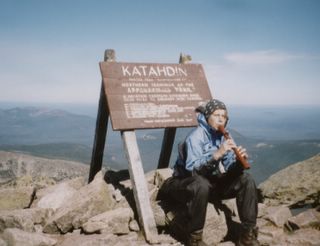
In 2003 and 2004, I was hiking on the Appalachian Trail, walking with spring, watching new life develop from what appeared to be cold and dead. There was a part of myself that was resurrected on my trek north. I was mourning the death of both of my parents in 2001, I’d just retired from my job and I was trying to understand just what I believed about God, life, death, humanity. My 2003 journal records the Easter meal, “Today is Easter. Our dinner consisted of the following ingredients all mixed together: chicken chunks, dried veggies, gravy mix, dehydrated milk, and stove top stuffing mix. Believe it or not, that doesn't taste too bad. Gary and I shared the pot of yummy stuff."

In 2004, we were in PA, “We got packed up about 9:30, just before the snow, or maybe we should call it sleet, came, not heavy, at first. Then it changed to flakes, then to drizzle. It is cold, not while hiking but when we stop, brrr. It wasn’t hard to get almost 13 miles in today because we really just wanted to keep going to stay warm. Today is Easter. Our dinner was tuna, noodles, and cheese spread on a taco shell.” Those two Easter Sundays were about as far removed from the memories of my youth as I could get except for the fasting part. Food takes on a whole new meaning when one is hiking on the AT. There is an appreciation for it that many Americans have never experienced.

Though the journal entries for these Easter Sundays do not give evidence of much reflection, my experience on the trail resurrected my belief in God, not the old man with the white beard, but my belief that God is in all of us and in everything if we only listen to our hearts and reach out with compassion to the world. Death is not an end but a new beginning. Life is not a line, but a circle. As I watched the white flowers poke through the brown leaves of the forests and looked from the mountain tops at clouds and stars, I felt so much a part of it all and at the same time so personally insignificant. I think this is the first time I celebrated the Spring Equinox as a spiritual event.

I spent last Easter and the one before in Columbus at a Methodist service where my daughter was singing in the choir. There were Easter lilies and stained glass windows. We sang, “Up from the grave He arose” , but in my heart, I wasn’t singing just about Jesus. I was singing that song of triumph for all of humanity, for the entire world. I was singing about flowers poking their heads out of dark cold earth, birds building nests and laying eggs with new life in them. I was singing about compassion arising from the ashes of our failed relationships with each other, and about people overcoming the slavery of addictions, prejudice, and hate as well physical slavery. This is the time of year to remember suffering people everywhere, not just the suffering of one man, and it is also the time to celebrate the victory we are capable of through the spirit of love we have within and among us.

Thursday, March 29, 2007

Jury Duty

Yesterday I finished my grand jury experience. In our county the grand jury meets one day every other week, and jurors serve for a three month period. Some states have eliminated the grand jury. Their argument is that it turns out to be just a rubber stamp for the prosecutor’s office and is therefore an unnecessary, time consuming and expensive step. After serving on our grand jury, I do not agree with this assessment. Even though in most cases we did indict, there were a few that we did not. To me the grand jury is a vital protection of our civil rights. What separates a democratic judicial system from a dictatorial one is oversight and participation by ordinary citizens, one’s peers. During the case presentations, we had the opportunity to question our prosecutor and law enforcement. Our job was not to determine someone’s guilt or innocence, but to ensure that citizens are not accused when the evidence against them fails to reach the level of probable cause. One can only imagine the stress, loss of income, expense of legal council, possible damage to one’s reputation, etc. that being accused and forced to make a defense in court can create. Accusing someone of a crime is serious, and citizens should be protected from possible abuse by government. As part of our oversight of our judicial system, grand jurors were even taken on a tour and treated to a jail lunch at the county jail. The consensus appeared to be that the prisoners were humanely treated and nutritiously fed. Even though our jail is modern, clean and well run, none of us desired to spend much time there.

That brings me to the other part of my day, the two hours in the morning before my jury duty. It was a beautiful spring day with a hint of rain to come. The dog woke me up early, and we watched the sunrise as we made our way to the park. The cumulonimbus clouds were a mix of gray and white etched with pink and gold as the sun tried to break through. The birds were everywhere, hopping robins, scolding blue jays, chirping cardinals and geese honking overhead as they made their way to the nearby lake. At one point, I even saw a crane fly overhead with its long legs and neck. As the dog played chase the stick and my eyes feasted on the yellow daffodils, I began to think about the people we had heard about during our jury duty in previous weeks. Some would surly be heading to jail where they would be deprived of this beauty for a long time. For the most part, the people we heard about did not intend to get into the mess they were in. They made bad decisions, often under the influence of drugs or alcohol or because of an addiction to them. When I took my summer school civics students on field trips to the jail, I always asked the officers leading our tour what percent of the prisoners were there because of alcohol or drugs. The answer was always 80 to 90%.

This nation needs to deal with its drug and alcohol problem. It is an epidemic that ruins the lives of and kills not only users and addicts but their family members and even strangers. The cost is tremendous when one considers auto accidents, higher insurance rates, health problems, broken homes, unemployment and lost time on the job, failure to pay child support, child neglect and abuse, domestic violence, crime, cost of law enforcement and prisons, educational failure, and deaths from overdoses and suicides. If there was ever a health problem that deserved our attention and funding for treatment and research to find a cure, addiction should be right at the top of the list, but it isn’t. Why?

One reason is that like obesity, we tend to blame the victim instead of treating the disease. Another reason is that many of us have the disease and are blind to the symptoms because of denial. We fight coming to grips with the problems addiction is causing in our own lives and the lives of our loved ones. As a society, we have grown so used to addiction that we assume it is normal state, and we cannot do anything about it. It is such a part of our social life that it is hard to go anywhere that people are gathered for recreation where it is not present and being abused. Legal drugs are advertised that claim to do everything from stopping hair loss to giving us a good night’s sleep and even improving our sexual experiences. They are advertised, not just with the facts but with all the glitz, comedy and persuasive propaganda the drug companies’ ad agents can muster. Our government’s response, the War On Drugs has made the problem of addiction appear to be a threat from somewhere else, not a problem we need to be personally involved in solving with our family members, our neighbors and our friends.

On the bright side, public awareness seems to be increasing. I’ve seen more media attention to the subject with more accurate information. HBO recently partnered with NIH and aired a 90 min. special and CNN's Lou Dobbs had a special, The War Within. The congress is considering a bill to force insurance companies to cover mental health issues including drug and alcohol addiction on an equal basis with physical ailments. The House and the Senate each have introduced a bill though the House bill is the stronger of the two. If you care about this issue, now is the time to call or write your representatives to get their support for this important legislation.

Monday, January 08, 2007

More About Change

On Sunday our Midday Service had a ritual that focused on forgiveness. We were asked to write something we wanted to let go of on a piece of white paper with a water color marker. Then we brought our paper to a bowl on the alter and dropped it in so that the ink slowly dissolved. I thought about a lot of things I wanted to be rid of at the start of this new year, but found I could sum them all up with, "Attachment to that which was not, is not, or cannot be." The Buddhists believe that all of our suffering is a result of our attachments. Certainly attachment to things past often keeps us from enjoying or even dealing with the present situation. Pain from the past remembered in the present brings suffering in the here and now. Old resentments not only cause suffering for us but for others around us.

I like the story of the wise teacher who dealt with the grudges of his students by telling them to write the names of all those they were angry with on a raw potato and carry the potatoes with them in a burlap bag until they could forgive. Not only did the bags grow heavy, they began to smell pretty awful. That is what happens when we carry resentments and anger with us; it pollutes our present and makes us unpleasant for others to be around. Even being unable to forgive our own short comings keeps us attached to past mistakes instead of making a new start in the present.

It is not hard to know when we are attached to things from the past. It is harder to know when we are attached to that which is not. Our inability to perceive the present is often affected by our attachments to worn out concepts developed in the past, prejudices, habits, and perceptions that we have failed to update with a fresh look. Often we fail to see what is because we do not want to face the truth. Sharing perceptions with others can often help us see things more clearly. One is reminded of the story of the four blind men feeling the elephant.

One felt the trunk, one the tail, one a leg, one another part, and each got a different perception of what an elephant is. Only by sharing their perceptions could they get a true picture of the whole animal. Our attachment to a false perception of our present situation may keep us from enjoying it or dealing with it in the best way possible. Another story that I like is a Zen story about a man being chased by a tiger. When he comes to a cliff, he goes over edge to avoid the tiger and grabs a branch on the way down. At the bottom is another tiger waiting for him. While hanging by the branch, he sees a beautiful strawberry growing within reach. A strawberry never tasted so good! Had the man been concerned about the tiger in the past or the tiger in the future he may never seen let alone enjoyed the strawberry in the present.

Attachment to anticipated events in the future is even harder to detect. Certainly it is important to plan and to some extent use the present to prepare for our future. The problem comes when we become so attached to our ideas about the future that we fail to appreciate the present. It is also hard to know when working hard for something in the present will bring the results we expect in the future. In dealing with my anxiety of the future, I often meditate on the AA serenity prayer. God grant me the courage to change the things I can, accept the things I cannot change and the wisdom to know the difference.

Attachments to things that were not, are not, and cannot be, keep us from enjoying what is and stop us from making needed changes to deal with the life we have in the here and now.

Wednesday, January 03, 2007

Change: My devil and my angel

Jamie had a link from his page to the UU Carnival topic of change, so I decided to try writing on this topic.

The New Year is here! Every January First I feel like a grade school kid in art class who has just been presented with a big blank sheet of white paper. No matter how I messed up the last year, this is the opportunity for a fresh start. It is a chance to imagine and plan my perfect year before I put the metaphorical crayon to paper and find that my artistic talents do not in any way match my imagination.

Most of us make the obligatory New Year’s resolutions and keep few to none of them. So, the question then becomes why is it so difficult to change even when we obviously wish (at least to some extent) that something in our life was different? I find myself thinking about my desire to change in terms of the cartoon character with the little cartoon angel on one shoulder and the devil on the other. The angel in this case is the force in my life that motivates me to make a healthy change and the devil is the bad, but quite comfortable, habit that lures me back to the evil side despite my wonderful intentions.

So, from the good angel perspective, I’ll consider the motivations that have worked for me in the past. First, most major changes I’ve made I my life have come through some significant emotional event, usually traumatic and painful. To give just one example, my resolve to drink no more than two alcoholic beverages in an evening did not lead to moderate drinking, but painful experience was a much more potent motivator. It is unfortunate that one has to suffer emotional or physical pain to listen to the wise angel of one’s better self, but that often seems to be what it takes. The second way I’ve found to change is to replace a bad but comfortable habit with another that I’ve persuaded myself will be more interesting and fun. For example, I am not very motivated by the idea of exercising even though I know that I need to do so. Sitting at the computer, reading a good book or watching TV when I come home from work is more inviting. However, I am motivated to spend time chatting with friends. About five years ago, while attempting to make good on my umpteenth resolution to exercise on a daily basis, I happened to pass my neighbor’s house and casually mention that I was giving the exercise thing another go. She convinced me to walk all the way downtown with her, about three and a half miles round trip. We had a great time talking, walking and laughing, and we have been walking through the sun, rain and snow four to five times a week ever since. We have even added another friend to the fellowship, and that has made it even more fun.

Now onto the devil sitting on my other shoulder, Newton's first law states that “a body at rest remains at rest and a body in motion continues to move at a constant velocity unless acted upon by an external force.” Inertia is the biggest obstacle to change. I’m very good at convincing myself that any change will require an ENORMOUS if not INSERMOUNTABLE amount of effort. This negative self-talk has managed to derail most of my New Years resolutions before I even get started. One of the tricks I learned while studying for my counseling license was that helping people make changes is best done by getting them to set short term objectives instead of making sweeping resolutions.

The problem is that most of us want instant change and are not very satisfied by taking “baby steps”. That is why self-help groups like, AA and weight watchers are successful. The group members help us break the task into smaller steps and act as a cheering section to give us validation that we are making progress. They act as an external force helping us to overcome our inertia and change direction.

Well, I’m off to work on my New Year’s resolution. The devil of inertia is beckoning me to avoid cleaning the study by making this post a bit longer. She’s telling me to look around at the mess and telling me that dealing with it is an impossible task. The angel is suggesting that I start with just cleaning off one shelf of the bookcase that is stacked high with papers I need to file or pitch. Anyone want to join a self-help group for the organizationally challenged?

Sunday, December 31, 2006

Ripples

As we go through life we cannot help but make ripples in the ocean of time. Even those who have no power or position make a difference in the lives of others, and that difference may reverberate to make an even greater impact. This week the death of three leaders filled the news, Gerald R. Ford, James Brown and Saddam Hussein. Interestingly all three men had been abandoned by their birth fathers early in life, and all came from humble beginnings, not born into families of power or wealth. Yet each of these men became known throughout the world and their death is a major news story. Each made not just a ripple in time, but a splash that has affected millions of lives and changed history.

It seems strange to talk about these men in the same post since they have little in common except for their prominence and their time of death. The contrasts between their lives seem to vastly overshadow any commonality. Yet, I cannot help but wonder how they came to make a splash instead of just a ripple. What was it about them that made people follow them?

I find President Ford’s position easier to understand than the other two. He lived what to most of us was an exemplary life. He was the all American boy, hard working, faithful, kind and loving, the kind of guy you would want for a friend. He studied hard, was a good father and husband, and embraced and exemplified the values that most of us hold dear. He did not seek the position that gave him his great fame or influence, but handled leadership with humility and great wisdom. I can understand why the people of Michigan chose him to represent them for so many years in the House of Representatives. They made a good choice, and he was there for this country when we needed his steady hand.


It isn’t too hard to understand how James Brown became famous; one only needs to listen to the music. Brown’s rhythm and blues funky sound fills the soul with energy, and puts our bodies in motion. He filled African Americans with black pride and connected a nation that seemed culturally divided through music that brought its young people together. His personal life was filled with struggles and certainly doesn’t inspire our emulation, but that did not keep us from admiring his creativity and his energy.


While the world greeted the deaths of President Ford and James Brown with accolades and sadness, some rejoiced over the death of Saddam Hussein. Even those who morn his passing do not do so with fond remembrance but with anger and hate for those who have brought about his fall from power and his death. How did this man from humble beginnings rise to a position of leadership? He stood alone on that gallows, but he did not do the crimes alone. While we are quite willing to identify with the wonderful personal values of Ford and the creativity and energy of Brown, we have a problem owning the emotions and values that brought Hussein to power. Yet, they are every bit as common to us as the others. Saddam Hussein represented power for people who were powerless. He kept warring factions in check with brutality and fear. He brought modernization and stability to Iraq and increased living standards for many who had formerly lived in poverty under a monarch. No leader is able to commit “crimes against humanity” alone, there must be thousands of coconspirators, people who are willing to trade humanitarian values for power, money, or the illusion of safety. I am saddened by the death of Saddam Hussein, not that I condone what he did, but I feel compassion for him, and for the rest of us too. The people of this nation have at times supported leaders whose actions have traded humanitarian values for wealth, power and the illusion of safety.

The lives of these three men cannot be taken out of the context of history. The splash they made in the ocean of time was affected by the currents and the prevailing winds. The ripples made by others impacted them and through them, the rest of us and future generations as well.